What “forward deployed” actually means
It's not sales engineering and it's not consulting. It's writing the platform with the customer in the room — and being strict about what goes back into it.

People ask what a forward deployed engineer does, usually right after I say I spend a good part of my week in a client's office. The polite answer is "I build the product where the problems are." The honest answer is longer, because the role is easy to describe and hard to do well, and most of the ways to do it badly look fine for the first six months.
This is what the job looks like from the inside, for anyone weighing it up or hiring for it.
The short definition
A forward deployed engineer is a product engineer whose desk happens to be next to the customer. You write production code, in the main repository, against the same standards as everyone else. The difference is where your inputs come from. You don't get requirements from a product manager who heard them from an account manager who heard them in a meeting. You watch the work being done, you see where it hurts, and you change the platform so it hurts less.
That last part — change the platform — is the whole job. Everything else is in service of it.
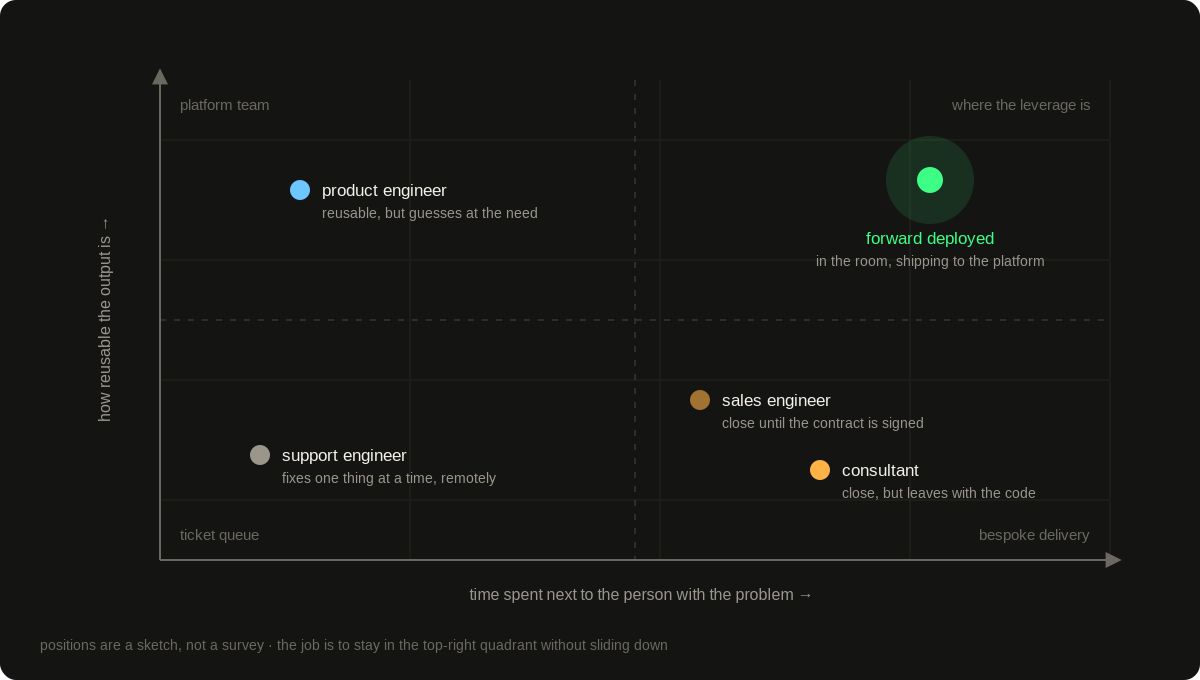 The trick is staying in the top-right: close to the problem, and still shipping things every tenant can use.
Three things it is not
It is not sales engineering. Sales engineers are excellent and close to the customer, but their work ends when the contract is signed. My work mostly starts there. Nobody is waiting on me to close a deal. The deal is closed; now the thing has to work, on their network, with their identity provider, for people who never asked for an AI assistant and are not sure they want one.
It is not consulting. Consultants are also close, and they often build things. But what they build usually leaves with them, or stays behind as a one-off that nobody can maintain. I don't hand over a slide deck or a zip file. If a need comes up on Tuesday, there is a branch for it by Thursday, and that branch goes through review like any other.
It is not a custom build shop. This is the subtle one, and it is where most teams in this role go wrong. Every ask from the field is really a question: is this one customer, or is this the next platform capability? Saying yes to the customer is easy. Saying yes and still shipping something reusable is the skill.
Why the role exists at all
Enterprise software has a distance problem. The person who has the problem and the person who can fix it are separated by five or six hops: user, their manager, the client's IT team, the vendor's account manager, a product manager, a ticket, an engineer. Each hop loses detail. By the time the engineer reads the ticket, "the assistant gives wrong answers about leave policy" has become "improve retrieval quality," which is not a task anyone can finish.
Sit with the HR team and watch someone ask that question, and the actual cause usually shows itself in about ten minutes. Maybe the leave policy exists in three versions on SharePoint and the oldest one ranks highest. Maybe the user's question uses an internal acronym that appears nowhere in the documents. Maybe the policy is in a scanned PDF and the extraction dropped the table that holds the numbers. Each of those has a different fix, and none of them is "improve retrieval quality."
Forward deployment removes the hops. That's the entire value proposition, and it's why it works.
A typical week
There's no such thing as a typical week, but there is a rhythm I try to protect.
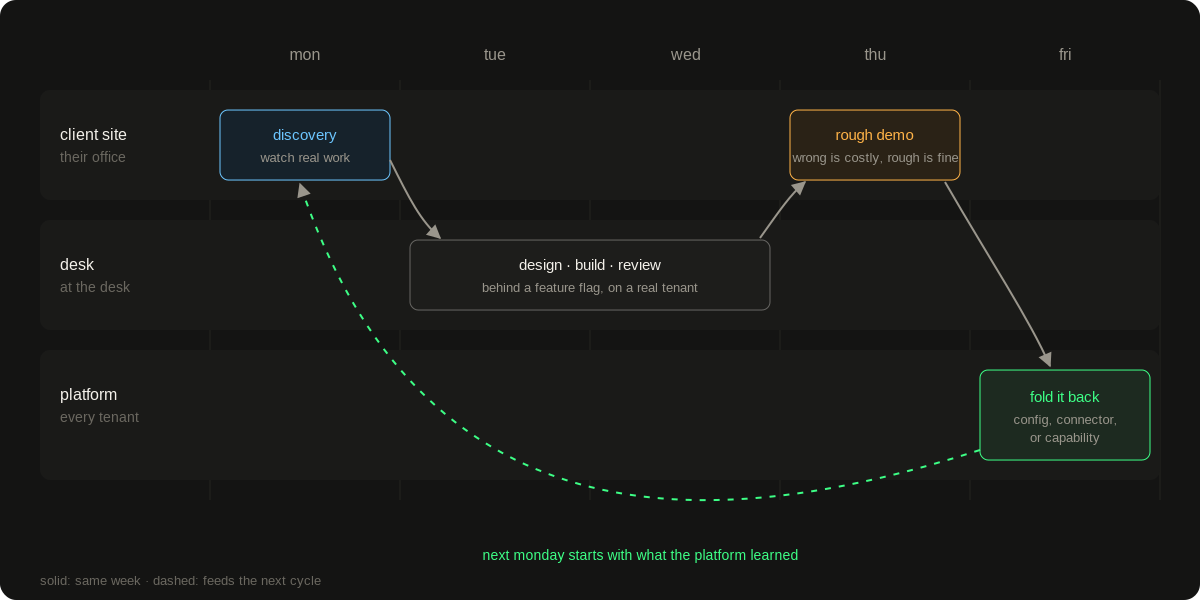 Discovery on site, build at the desk, demo back on site, then fold the result into the platform so the next tenant starts ahead.
Monday — discovery. I'm at the client site. Not in a meeting room presenting, but sitting with a team while they work. What do they do all day? Where would the assistant save them an hour, and where does it get in the way? I write down exact phrases people use, because those phrases end up in evaluation sets later.
Tuesday and Wednesday — build. Back at your own desk. Design, code, review. Everything goes behind a feature flag on the client's tenant, so I can ship to production without shipping to everyone. Most of what I build in these two days is small. The big things come from noticing the same small thing three times.
Thursday — demo. Back on site, showing whatever exists, even if it is rough. Rough is fine. Wrong is expensive. A rough demo on Thursday costs me a day; building the wrong thing for a month costs the relationship.
Friday — fold it back. This is the day most people skip, and it is the one that matters most. Whatever was learned that week gets turned into something the platform owns: a configuration option, a connector, a new evaluation case, a document for the next engineer. If Friday doesn't happen, the week was consulting.
The triage question
Every field request goes through the same question before anyone writes code. I picture it as a fork with four exits.
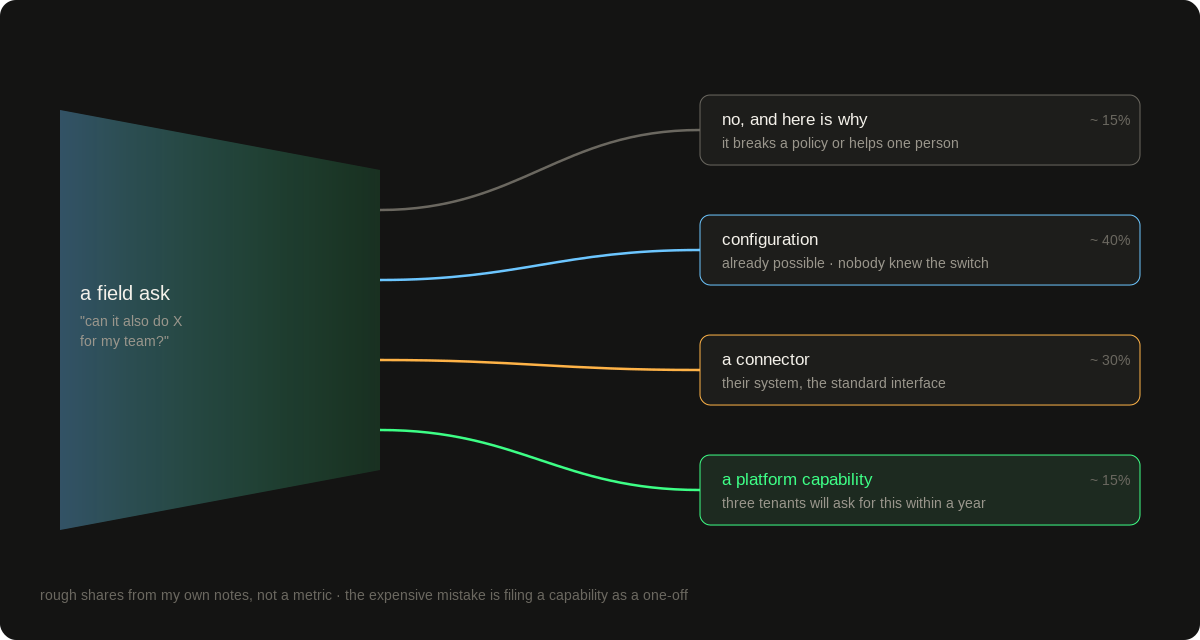 Most asks are configuration or a connector. The expensive mistake is filing a real capability as a one-off.
- No, and here is why. Some requests break a policy, or would only help one person, or contradict something another tenant depends on. Saying no clearly, with a reason, is part of the job. Clients respect a no that comes with an explanation far more than a yes that never ships.
- It's already configuration. A surprising share of asks are things the platform can already do. Nobody knew the switch existed. The fix is a setting and a short note in the admin docs — and a question to myself about why it wasn't discoverable.
- It's a connector. The client has a system the platform doesn't integrate with yet. Build a connector against the standard interface, so the next client with the same system gets it for free. Connectors are the best kind of field work: concrete, testable, reusable.
- It's a platform capability. Occasionally an ask reveals something every tenant will need within a year — permission-aware search, or an approval flow for agent actions, are typical examples. These go to the platform team with evidence — real usage, real phrases, real failure cases — and usually with a first version already written.
The failure mode is filing a category-four ask as a one-off: building it inside one tenant's configuration with special-case code, because it was faster. Do that a few times and you have a fork of your own product per customer. I have seen that happen elsewhere, and unwinding it costs more than building the platform properly would have.
How I keep custom work out of the codebase
A few rules that have held up:
- No tenant names in code. If you find yourself writing
if tenant == ..., stop. The behaviour you want is a configuration option with a sensible default. Name it after what it does, not who asked for it. - Every field change needs a second tenant in mind. Before merging, I write one sentence: which other tenant would use this, and how? If I can't write that sentence, it's probably configuration, or it's a no.
- Field code goes through the same review. It's tempting to give forward deployed engineers a fast lane. Don't. The fast lane becomes the place where shortcuts accumulate. Same reviewers, same tests, same release train.
- Evaluation cases are the real deliverable. Every bug found on site becomes a test case in the evaluation set — the user's actual question, the documents involved, the expected answer. Code fixes can regress. A test case keeps watch forever.
The skills that matter
I've hired for this role, and I've watched good engineers struggle in it. The technical bar is the same as for any senior engineer on the platform. What's different:
| Skill | Why it matters on site |
|---|---|
| Listening without solving | The first explanation of a problem is rarely the real one. Jumping to a fix too early anchors everyone on the wrong cause. |
| Saying no with a reason | Clients test boundaries. A clear no protects the platform and, oddly, builds trust. |
| Debugging other people's infrastructure | Their proxies, their identity provider, their air-gapped network. You will not have root, and you will need to be polite about it. |
| Writing for two audiences | A note for the client's leadership and a design doc for the platform engineers, about the same change, on the same day. |
| Comfort with partial information | You will never have the full picture of a large organisation's systems. You have to ship anyway, safely. |
The people who struggle are usually the ones who want to be told what to build. That's a perfectly good way to work on a platform team. On site, nobody will tell you. They will tell you what's annoying, and you have to work out the rest.
What it costs
It would be dishonest to make this sound purely good. The role has real costs.
Context switching is brutal. You hold a client's org chart, their systems, their politics and your own codebase in your head at the same time. Some days the hardest thing I do is remember which of four meetings a decision was made in.
You absorb frustration. When the assistant gets something wrong, the person in front of you is unhappy, and you are the nearest representative of the product. You learn not to take it personally, and to treat it as data. That takes time.
Deep work is scarce. Discovery and demos eat into the long uninterrupted blocks that good engineering needs. Protecting Tuesday and Wednesday is not a nice-to-have; without them, the build quality drops and the platform suffers.
Career paths are fuzzy. It's not obvious how forward deployed work maps onto a standard engineering ladder. Whoever leads the team should be explicit that platform impact is what counts — a connector three tenants use counts for more than a heroic one-off for one.
What I'd do when setting one up
If you're setting up a forward deployed team from scratch:
- Start the evaluation set on day one. Teams often start collecting real user questions as test cases months in. Every week before that is lost signal.
- Write the triage rules down early. If the four-way decision lives in one person's head, new engineers make reasonable but inconsistent calls. A one-page document fixes most of that.
- Pair new engineers on site before sending them alone. The technical work transfers easily. The judgement about when to say no does not, and it's learned by watching.
- Budget Fridays explicitly. Folding work back into the platform is the first thing to get squeezed when a client is pushing. It should be protected on the calendar, not left to good intentions.
Why I like it anyway
After fourteen years of building platforms, the most useful thing I've learned is that the distance between a problem and its fix is where most enterprise software quietly fails. Forward deployment is just the decision to close that distance on purpose, and to be disciplined about what you bring back.
It's tiring. It's also the most direct line I've ever had between the code I write on Wednesday and someone's work being easier on Thursday. That's hard to give up once you've had it.