Udaipur to Abu Dhabi, by way of a few racks
Fourteen years, seven companies, three countries. A look back at what each stop taught me, written a month into starting from a blank repository again.

A month ago I joined AI71 in Abu Dhabi to build an enterprise AI platform from the first commit. On my first day the repository was empty. That doesn't happen often in a career, and it made me look back at how I got here — from a desk in Udaipur, writing education software with a friend and a very optimistic business plan.
This isn't a résumé. It's the list of things each stop taught me that I still use, written down before the new job fills every available hour.
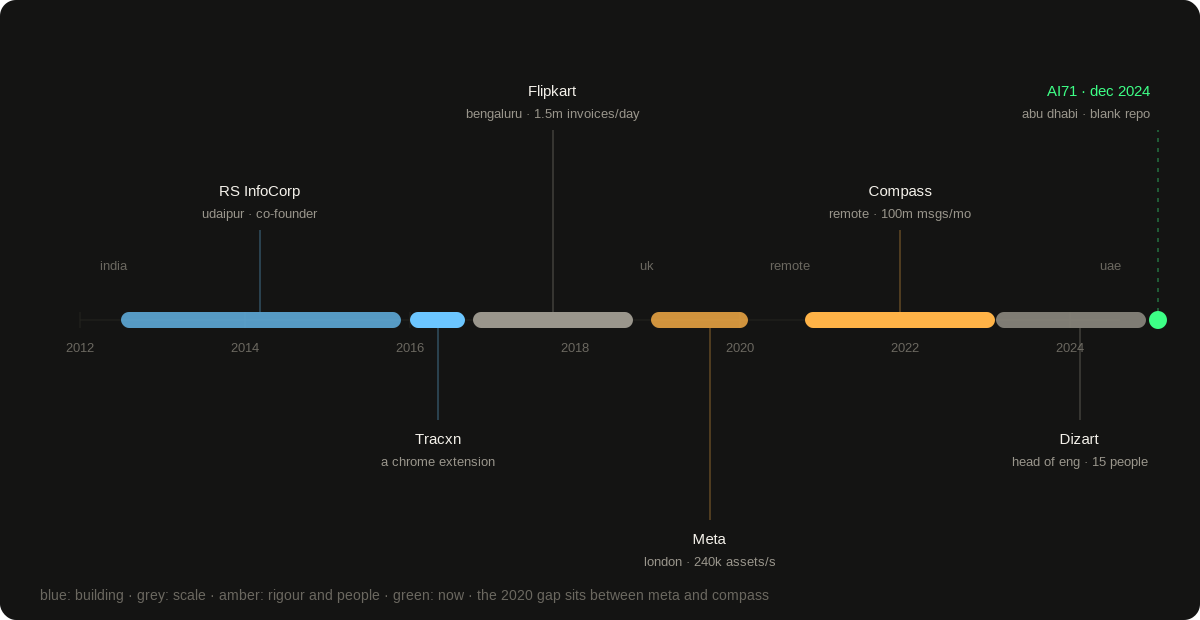 Seven stops across India, the UK, remote work and now the UAE.
2012 — Udaipur, and the whole job at once
I finished my B.Tech in computer science at Rajasthan Technical University in 2012. Somewhere in those years I'd picked up a gold medal in C programming from NPTEL and a GATE score in the 93rd percentile, which mostly told me I liked the fundamentals more than I liked exams.
Instead of joining a large company, I co-founded RS InfoCorp, a small services firm in Udaipur. We built education platforms for Indian institutes. "We" was a very small number of people, so I did everything: requirements meetings with the people who'd use the software, the database design, the code, the deployment, and, at the end of the month, the invoice.
That last part taught me more than I expected. When you send the invoice yourself, you develop a very clear sense of what the customer actually values, as opposed to what you enjoyed building. Those are often different things. A feature I was proud of might go unused. A small report that took me an afternoon might be the reason they paid on time.
What I still use: requirements, code, deploys and invoices are all the same job. If you only see one slice, you optimise the wrong thing.
2016 — Tracxn, and leverage
After three and a half years I wanted to see how software was built at a company with a real product and real users at scale. I joined Tracxn in Bengaluru, working on the core frontend.
The part I remember is a Chrome extension: a small tool that put company data where people were already working, inside their browser. It ended up accounting for roughly thirty percent of company revenue.
That was my first real lesson in leverage. The extension was a tiny amount of code compared to the main product. But it met users where they were, instead of asking them to come to us. I've thought about that extension a lot recently, because putting an AI assistant inside Slack and Teams, rather than in yet another web app, is the same idea at a different scale.
What I still use: the best distribution is the place your users already are.
2016 to 2018 — Flipkart, and what scale feels like
At Flipkart I worked on invoice generation and document signing, and on bringing third-party orders into the order management system. The invoice system handled around one and a half million documents a day.
At that volume, every rare event happens daily. A one-in-a-million edge case isn't an edge case; it's a recurring ticket. A thirty-second slowdown in signing isn't a blip; it's a backlog of tens of thousands of documents that customers and sellers are waiting on.
I learned to think about failure as a normal operating condition. Retries, idempotency, reconciliation jobs that compare what should have happened with what did — these stopped being advanced topics and became the default way I designed anything.
What I still use: design for the failure that happens every day at scale, not the happy path that happens most of the time.
2018 to 2020 — Meta, and invisible rigour
Moving to London to join Meta was the biggest change of setting in my career. I worked on integrity pipelines — machine learning systems filtering around two hundred and forty thousand media assets per second for safety — and on supplier portals that handled about forty billion dollars a year in transactions.
What surprised me most wasn't the scale, though the scale was remarkable. It was how much care went into systems nobody outside the company would ever see. Code review was thorough. Design documents were real documents. Rollouts were gradual and measured. Nothing was "done" until there was a way to know it was working.
I also conducted about a hundred interviews there, which was my first real exposure to hiring as a discipline rather than a chore. Watching how a well-run interview process works — structured questions, written feedback, calibration — shaped how I hire now.
What I still use: rigour isn't for show. It's what lets a large group of people change a critical system without breaking it.
2020 to 2023 — Compass, and the boring systems people notice
At Compass I worked on notification systems for a fast-growing real estate platform, dispatching around a hundred million notifications a month across email, push and SMS, and on a Twilio-based messaging platform underneath it.
Notifications are a strange kind of system. When they work, nobody thinks about them. When they don't — a duplicate message, a push at three in the morning, a missing alert about an offer on a house — people notice immediately and remember for a long time.
I learned that "boring" infrastructure deserves product thinking. Who receives this? When? How often is too often? What happens if we send it twice? Those are product questions, and treating them as engineering details is how you end up with a system that technically works and annoys everyone.
What I still use: the systems users notice most are often the ones engineers find least interesting. Give them an owner.
2023 to 2024 — Dizart, and running teams
At Dizart I became head of engineering. I built the team from scratch as a distributed organisation across multiple countries, eventually leading fifteen engineers across three teams. We shipped a blockchain-based marketplace that processed around seventy million dollars in sales, generative AI media products like face-swap video and voice transformation, and mobile applications for clients including Google and Sony.
This was the first role where my main output was other people's work. That transition is harder than it sounds. For a while I kept trying to be the strongest engineer on every team, which meant I was a bottleneck on every team. Learning to set direction, review designs, unblock people and then get out of the way took longer than I'd like to admit.
Running a distributed team also taught me to write. When people are spread across time zones, a clear written decision is worth more than any meeting. Most of my job became writing things down well enough that nobody needed to ask me.
What I still use: at some point your job becomes making other people effective. Writing is how you scale that.
2024 — AI71, and a blank repository
Which brings me to a month ago, and an empty repository in Abu Dhabi.
The goal is an enterprise AI platform for government entities: search that respects who is allowed to see what, assistants that can take actions safely, connectors into the systems people already use, and deployment that works on private infrastructure, including networks with no internet connection at all.
Every one of the stops above shows up in that list. The Udaipur lesson about seeing the whole job. The Tracxn lesson about meeting users where they are. Flipkart's failure-first design. Meta's rigour. Compass's respect for boring systems. Dizart's lessons about teams. None of it was planned. It just turns out that if you stay long enough at each place to see how things break, you collect the pieces you need later.
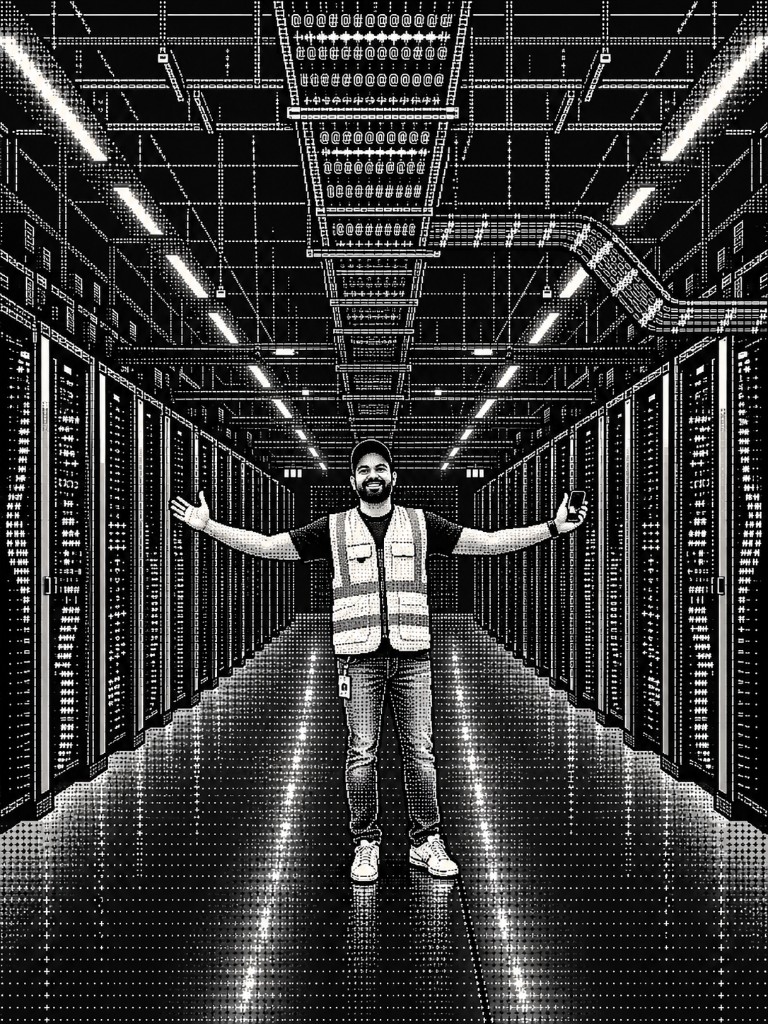 The aisle again, lights down. Every rack is somebody's 3am page.
What stayed constant
Looking at the timeline, the companies and countries changed a lot. The job didn't change as much as I'd have guessed.
Every role was some version of the same thing: take an idea, turn it into a system people depend on, and then stay long enough to learn how it fails. The staying part matters. Many of my most useful lessons came in the second year of a project, when the first design had met reality and lost.
The other constant is that I've never stopped writing code. Even as head of engineering, I kept a hand in the codebase. It keeps my judgement honest. It's very easy to make confident architectural decisions about systems you never have to debug.
What this blog is for
I'm starting this blog for the parts of the work that don't fit on a CV: the trade-offs, the mistakes, the patterns that only become obvious after you've seen the same failure in three different companies.
Some posts will be technical — permissions for AI agents, feedback loops for air-gapped systems, what a hundred million notifications teach you. Some will be about teams and hiring. Hopefully all of them will be useful to someone a few steps behind on a similar path, the way other people's writing was useful to me in Udaipur, a long time ago.