Hello, I'm Som
Udaipur, Bengaluru, London, and back to a desk in India in the strangest year any of us has had. Who I am, what I've built so far, and what this blog is for.
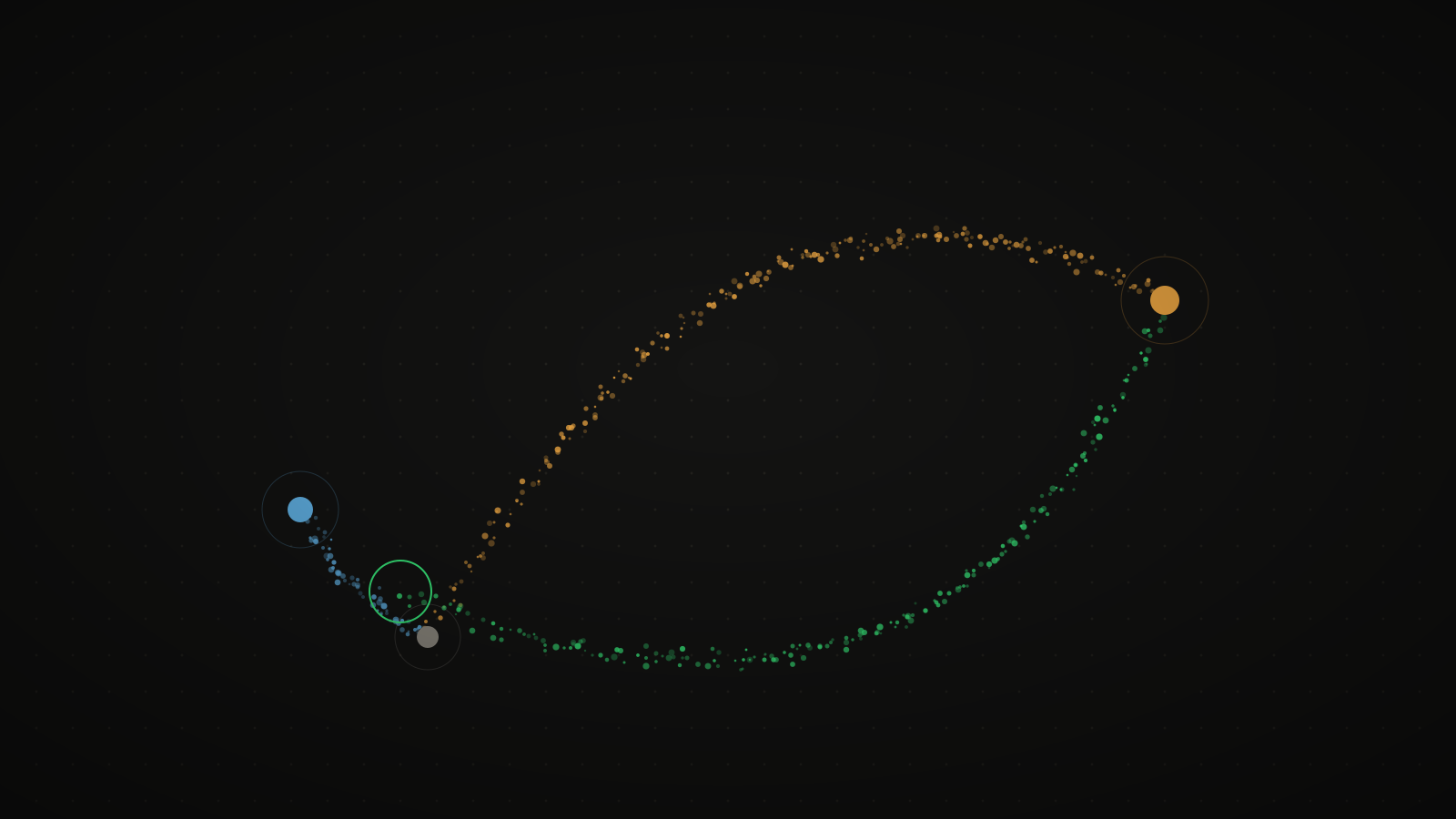
I've been meaning to start this for about three years. Every time, I'd open an empty file, write a heading, and decide the first post had to be clever. It doesn't. It just has to exist. So here's the plain version: who I am, where I've been, and why there's suddenly a blog.
My name is Som Nath. I'm a software engineer. I was born on 25 February 1991 in Udaipur, Rajasthan, and as I write this it's November 2020, I'm back in India, and I've just started a new job from a desk at home. That last part would have sounded odd a year ago. It doesn't sound odd to anyone now.
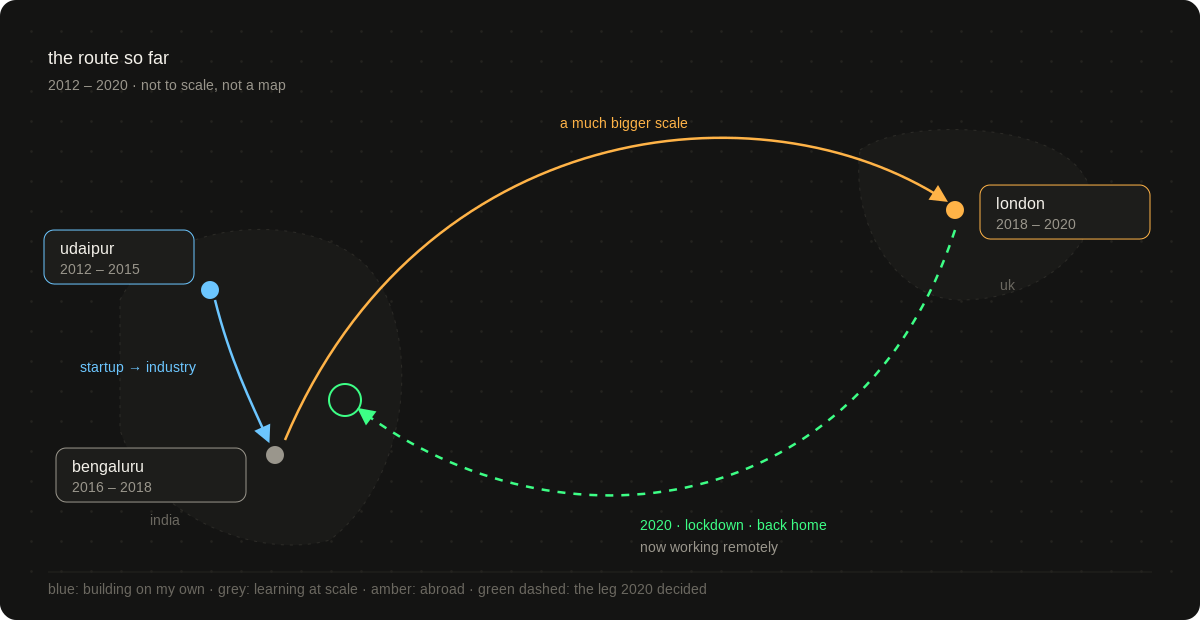 Four places, eight years. The last leg was not in the plan.
Udaipur
Udaipur is where I grew up, and it's where I learned that I liked making things that other people use. I did my B.Tech in Computer Science and Engineering at Rajasthan Technical University and graduated in 2012. Two things from those years I'm still quietly proud of: a gold medal in C programming through NPTEL, and qualifying GATE at the 93rd percentile. Neither changed my life. Both told me I could sit with a hard problem for longer than I expected to.
What I did right after college is the part that taught me the most. Instead of joining a company, I co-founded one. RS InfoCorp was a small services firm in Udaipur, and from 2012 to 2015 we built education platforms for institutes. "Small" is doing a lot of work in that sentence. There was no product team, no ops team, no one in charge of invoices. There was us.
That turned out to be the best training I could have asked for, because it made every part of the job visible at once:
- Requirements. Sitting with the people who would use the thing and working out what they actually needed, which was rarely what they first asked for.
- Code. Writing it, and then living with it, because there was nobody to hand it to.
- Deploys. Learning, the hard way, that "works on my machine" is the start of the job.
- Money. Quoting, invoicing, chasing payment. Engineers who have never sent an invoice have a slightly different relationship with scope creep.
I wouldn't say we got everything right. We didn't. But I came out of those three years with a habit I still have: I think of software as something that has to survive contact with real people, real servers and real budgets, not as something that's finished when the tests pass.
Bengaluru
By 2015 I wanted to see how software was built at a scale I couldn't reach on my own, so I moved to Bengaluru. It was a real shift: from building things independently to engineering inside larger organisations, with code review, on-call, and people who had solved my problems years before I met them.
My first stop, in 2016, was Tracxn, where I worked on the core frontend. I also built a Chrome extension that ended up contributing roughly 30% of the company's revenue. I didn't plan that. It started as a useful tool for one workflow and grew because people kept using it. That taught me something I've seen repeat since: the small thing that sits directly in someone's daily work often matters more than the big thing on the roadmap.
Later in 2016 I joined Flipkart, and stayed until 2018. This was my first time working on systems where the numbers stop being abstract. I worked on invoice generation and document signing that handled around 1.5 million documents a day, and on bringing third-party orders into Flipkart's order management system.
At that scale the interesting problems change. It's no longer "can we build this?" It's:
- What happens when the same request arrives twice?
- What happens when a dependency is slow for ten minutes on the busiest night of the year?
- How do you prove, months later, that a document was generated correctly?
None of those are glamorous questions. All of them are the job. Flipkart is where I learned to respect the boring parts of a system, because the boring parts are usually the ones that wake you up.
London
At the end of 2018 I moved to London to join Facebook, and worked there from December 2018 to February 2020. It was my first time working outside India, and the jump in scale was real again. I worked on ML pipelines for content integrity, filtering around 240,000 media assets a second, and on supplier portals that handled about $40 billion a year in transactions. I also did more than a hundred interviews across software and enterprise engineering roles, which taught me as much about how to explain my own work as about judging anyone else's.
What I'll take from that time technically is rigour. Systems that almost nobody outside the company will ever see were designed, reviewed and measured with enormous care, because at that scale a small mistake isn't small. A one-in-a-million bug happens every few seconds.
But London wasn't only a workplace, and I don't want to write about it as if it were. It was the first time I lived somewhere completely different, and it became an important chapter of my life in its own right. Some of what I learned there had nothing to do with code: how much of what I thought was "just how things are" was really just how things were where I grew up.
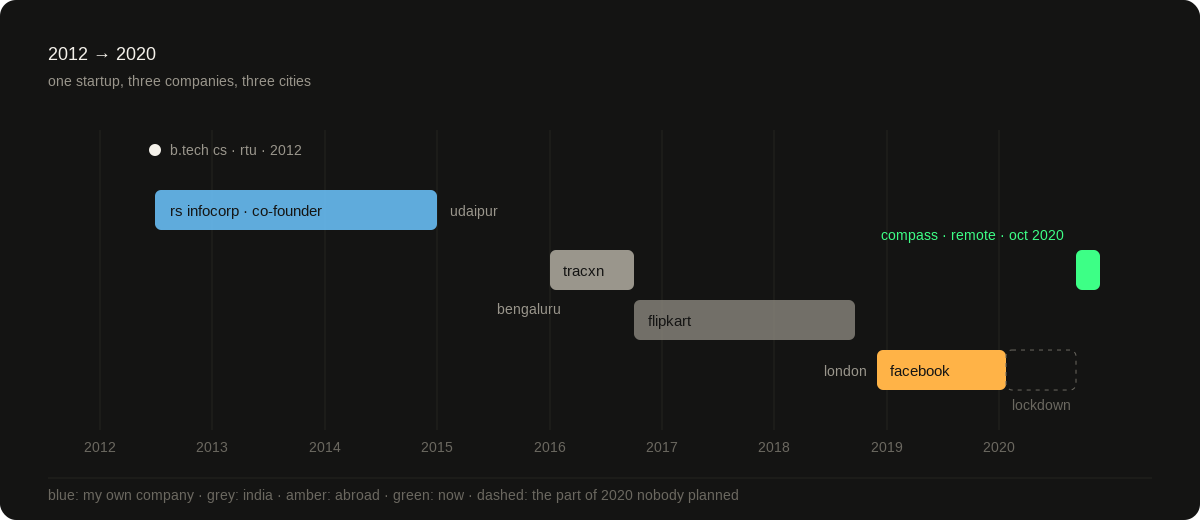 2012 to 2020: one startup, three companies, three cities, and a year nobody planned for.
2020
Then 2020 happened.
I left Facebook in February. A few weeks later the world closed. I won't pretend my version of this year was harder than anyone else's. It wasn't. Plenty of people lost far more than plans. But like a lot of people, I ended up back in India, spending months in lockdown, watching the idea of "where you work" quietly fall apart.
A year ago, a job was a building you went to. Now it's a laptop, a decent connection and a calendar full of video calls. That change is strange, and in some ways sad, and in some ways useful. For me it meant that in October I could start a new role without moving anywhere.
Now
I've just joined Compass as a senior software engineer, working remotely from India. Compass is a real estate platform, and I'm working on the notification systems: the part that tells agents and their clients that something has happened. A showing is booked, an offer comes in, a price changes.
It sounds simple. It's not. A notification is easy. Sending the right one, once, through the right channel, at a sensible hour, to a lot of people at once, is a system. I'm a few weeks in and I already have a list of things I want to write about.
What this blog is for
I want to write the things that don't fit anywhere else. A CV can say I worked on a system that handled a million and a half documents a day. It can't say what went wrong on the night it nearly didn't, or which design decision I'd make differently, or what I learned from the person who reviewed my code.
So, roughly, three kinds of posts:
| Kind | What it covers |
|---|---|
| Systems | How things at scale actually behave: idempotency, retries, queues, the boring parts. |
| Work | Building things for real people, from requirements to production and after. |
| Notes | Shorter things I learned, changed my mind about, or want to remember. |
I'll try to write the way I'd explain something to a colleague over chai: specific, honest about what went wrong, and without pretending any of this is easier than it is.
A small promise
I'm not going to post on a schedule. I've tried schedules; they produce posts that exist to fill a slot. I'll write when something is worth more than a commit message.
If you've read this far, thank you. If you're working on something similar, or you disagree with something I write later, I'd genuinely like to hear it. That's half the reason for doing this in public.
More soon. Probably about notifications.